
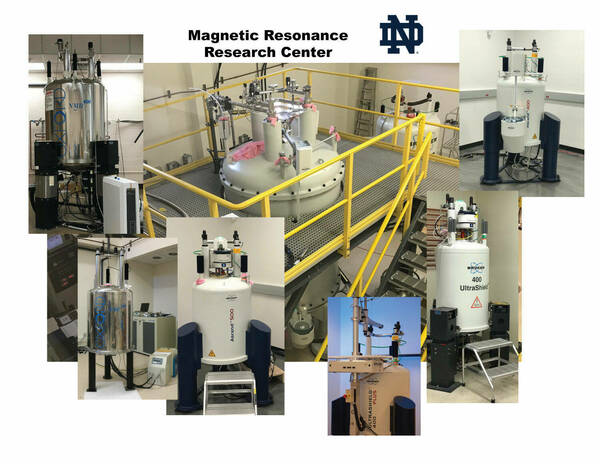
The Magnetic Resonance Research Center (MRRC) supports research in chemistry, biochemistry, molecular biology, engineering and related fields. The MRRC operates six solution-state NMR spectrometers (400 to 800 MHz), a solid-state 300 MHz NMR instrument, and an X-band EPR spectrometer. Most instruments are equipped with sample changers for increased sample throughput and automation.
See our presentation of capabilities and policies at Access Technology Program Seminar Series of Indiana CTSI:
Instrumentation
The flagship instruments of MRRC are the Bruker 800 and 700 MHz spectrometers enabling measurements of dilute sample solutions of large and small molecules. The Bruker 500 and three 400 MHz instruments are workhorses for a daily work of Notre Dame chemists and biochemists. A fully automated Bruker 400 MHz system in McCourtney Science Hall enables new users to perform NMR measurements from day one even if they have very limited NMR experience. The solid-state JEOL 300 MHz NMR instrument equipped with a Magic-Angle Spinning (MAS) probe enables NMR measurements on powders in chemical and engineering research. The X-band Bruker EMX EPR instrument is equipped with ColdEdge cryogenic accessory allowing EPR measurements in a full range of sample temperatures all the way down to 11 K.
Research Support and Training
The Center supports a diverse range of research projects at the University of Notre Dame in chemistry, chemical engineering, biochemistry, biophysics, cellular and molecular biology, and related fields, and provides NMR analytical support for academic research groups, institutions and corporations off-campus. All users are trained to operate instruments on their own while booking instrument time through an online scheduling system, iLab. The MRRC staff provides all training free of charge. When more assistance is needed, the MRRC may perform consulting services for a nominal fee or collaborate with research groups (with a co-authorship for MRRC staff).